Fire Pit Safety & Propane Use Policy
Built for backyard glow, used the right way every time.
My Luxe Backyard sells both propane and wood-burning outdoor fire pits, built to bring warmth and ambiance to patios and backyards across the Continental United States. This page sets out, in full, how to set up, place, fuel, light, and maintain the fire pits sold on this site safely, along with the federal product-safety standards and state and local fire rules every owner should know before the first flame.
A retailer's honest account of how fire pit safety actually works here
My Luxe Backyard is owned and operated by Navarro Living LLC. We are a retailer, not a manufacturer, and our current fire pit collection includes both propane-fueled fire pit tables and a traditional wood-burning fire pit. We sell to customers across the Continental United States only.
Because an open flame and pressurized propane are involved, we wrote this page to walk through, in plain language, how to place, fuel, light, maintain, and extinguish the fire pits we sell, what federal product-safety standards apply to propane appliances, and why state and local fire codes always have the final word on whether and how you can burn in your specific location.
This page is general safety guidance for the products we sell. It is not a substitute for the manufacturer's printed manual that ships with your fire pit, which always takes priority for the specific model you purchased.
What the words in this policy actually mean
Fire pit and propane terminology gets used loosely. Here is exactly what each term means when we use it on this page or on a product listing.
Propane Cylinder
The portable steel tank, most commonly a standard 20 lb (5-gallon) cylinder, that fuels the propane fire pits we sell. Cylinders are sold separately and must carry a working Overfill Protection Device (OPD) valve.
BTU (British Thermal Unit)
The standard measurement of heat output. The propane fire pits in our collection are rated between 30,000 and 40,000 BTU, which determines how much area the unit can comfortably warm.
Clearance Distance
The minimum open, unobstructed space recommended between a lit fire pit and any structure, railing, fence, overhead canopy, or combustible surface, to reduce the risk of scorching, melting, or ignition.
Open Burning / Burn Ban
Local restrictions, sometimes seasonal or weather-triggered, that limit or prohibit outdoor fires, including wood-burning fire pits, within a city, county, or HOA community. These rules sit entirely outside our control.
What we sell, and the fuel-specific points each one calls for
Each fire pit we carry has its own fuel type, heat output, and handling needs. Full specifications and the manufacturer's printed safety instructions ship with every unit and also live on the individual product page.
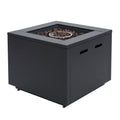
30 In. Black Steel Propane Fire Pit
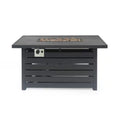
40,000 BTU · 50 sq ft heated areaA square galvanized steel propane fire table that connects to a standard 20 lb propane cylinder. Push-button or match-lit ignition depending on configuration, with a control valve that should always be checked for a tight seal before each use.
23 In. Iron Rectangle Propane Fire Pit
30,000 BTU · concealed tank compartmentAn iron and MGO fire table with an enclosed compartment that hides the propane cylinder and eliminates exposed hoses. The enclosed design still requires the same ventilation, leak-check, and clearance practices as any propane appliance.
29 In. Stone Gray Wood Fire Pit
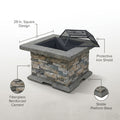
Wood-burning · open flameA traditional wood-burning fire pit with no fuel line or pressurized components. It carries its own set of considerations, including spark control, ash disposal, and local rules around open burning that propane units do not face.
Handling propane cylinders the right way
Propane fire pits are convenient, but the cylinder itself deserves the same respect as any pressurized fuel source. These four habits cover the basics for every propane unit we sell.
Check the cylinder first
Use only a properly filled, certified 20 lb propane cylinder with a working OPD valve. Inspect it for dents, rust, or damage, and confirm the certification date stamped on the collar has not expired before connecting it.
Test every connection for leaks
Before first use and at the start of each season, apply a soapy water solution to all hose and valve connections with the gas on and the burner off. Bubbling means a leak. Tighten or replace the connection and retest before lighting.
Keep it outdoors, always
Propane fire pits are designed for open-air outdoor use only. Never operate one inside a garage, screened porch, fully enclosed patio, tent, or any space without substantial open-air ventilation.
Store and transport upright
Keep spare or disconnected cylinders outdoors, upright, in a well-ventilated area away from direct sun and ignition sources. Always transport cylinders upright and secured, and never leave one inside a closed vehicle.
If you ever smell gas, hear hissing, or suspect a leak that does not stop with the valve closed: shut off the cylinder if it is safe to do so, move away from the area, and do not attempt to light the fire pit or operate any switches nearby until the leak has been resolved by a qualified technician.
Where a fire pit belongs, and where it doesn't
Safe placement, every time
Place any fire pit on a level, non-combustible surface such as concrete, stone, brick, or gravel. Keep a minimum clearance of several feet from your home's siding, railings, fences, overhanging branches, and any retractable canopy or pergola roof, and increase that distance further for the higher-BTU units in our collection. Always check the specific clearance distances printed in your model's manual, since they vary by BTU output and design.
Decks, patios, and covered spaces
Wood decking and most synthetic decking can scorch or melt under sustained heat. If you place a fire pit on or near a wood or composite deck, use a heat-rated fire pit pad or mat rated for the unit's BTU output underneath it. Under any pergola, gazebo, or roofed structure, confirm you have enough overhead and side clearance for smoke and heat to dissipate safely, and never operate a fire pit directly beneath a retractable fabric canopy.
The federal, state, and local rules behind this policy
This page is written to operate within, not around, the safety standards and local authority that already govern outdoor fire appliances. Two bodies of rules matter most here.
Federal Product Safety Standards
State & Local Fire Authority
This section is provided for transparency and general information. It is not legal or fire-safety certification advice, and rules vary by state, county, and municipality. Before your first use, confirm current requirements with your local fire marshal or fire department.
Four habits for every session, start to finish
Inspect and place
Read the manufacturer's manual for your specific model. Set the unit on a level, non-combustible surface with full clearance from structures, plants, and anything overhead. Check propane connections or, for wood, confirm there is no active burn ban.
Check the conditions
Avoid lighting any fire pit in high wind, under dry drought conditions, or near falling leaves and dry brush. Keep a fire extinguisher, garden hose, or bucket of sand within easy reach before you light it.
Light it and stay with it
Follow the model's specific lighting instructions. Never leave a lit fire pit, propane or wood, unattended, even for a few minutes, and keep children and pets at a safe distance from the flame and any hot surfaces at all times.
Extinguish and store safely
Close the propane valve fully or smother wood embers with sand or water until cold to the touch. Disconnect the cylinder when not in use and let the unit cool completely before covering, moving, or storing it.
What these fire pits are not intended for
The fire pits sold on this site are decorative and ambiance heating appliances for outdoor residential use. They are not intended as a cooking surface unless the product page specifically states otherwise, are not designed for indoor or commercial use, and should never be modified, have their gas components altered, or be connected to a natural gas line unless the manufacturer explicitly supports that configuration.
This doesn't replace the manufacturer's manual
This page is general guidance covering the fire pits we currently sell. The printed manual that ships with your specific unit always governs for that model's exact clearance distances, BTU rating, ignition method, and maintenance schedule. Where this page and your manual differ, follow the manual.
Independent places to learn more or raise a concern
These federal and state resources exist for any consumer, anywhere, and operate independently of My Luxe Backyard. We would still encourage you to contact us first at support@myluxebackyard.com so we can help directly and quickly.
National Fire Protection Association
Public guidance on outdoor fire pit and patio heater safety, clearance distances, and seasonal fire prevention.
Visit NFPA.orgU.S. Consumer Product Safety Commission
Report a safety concern with a propane or gas outdoor appliance, or check for open recalls before you buy.
Report or search safety issuesPropane Education & Research Council
Independent consumer education on propane cylinder handling, leak checks, and seasonal storage.
Visit Propane.comNew Jersey Division of Fire Safety
The state fire authority for Navarro Living LLC's registered address, for general fire code and burning questions.
Visit the DivisionFiling a report or inquiry with any of these agencies is free, voluntary, and entirely separate from any product question you raise with us directly. Local fire codes and burn restrictions are set by your own city, county, or fire district; please check with your local fire marshal for rules specific to your address.
Questions about safe use? Talk to our team
We're available Monday to Friday, 9:00 AM to 5:00 PM Eastern Time. Messages sent outside these hours are answered the next business day.
Navarro Living LLC (Company Registration No. 0451 452883, EIN 42-2132746) is an independent retailer of pergolas, gazebos, patio furniture, fire pits, saunas, and cold plunges, and is not the manufacturer of these products unless specifically stated on a product page. This Fire Pit Safety & Propane Use Policy provides general guidance and does not replace the specific manufacturer instructions, warnings, and clearance distances printed in the manual shipped with your fire pit.
This policy was last updated and is effective as of July 1, 2026. It is reviewed regularly and may change as our product range or applicable safety standards change. For details on returns, see our Return & Refund Policy, for shipping, see our Shipping Policy, and for how we collect and use your information, see our Privacy Policy.